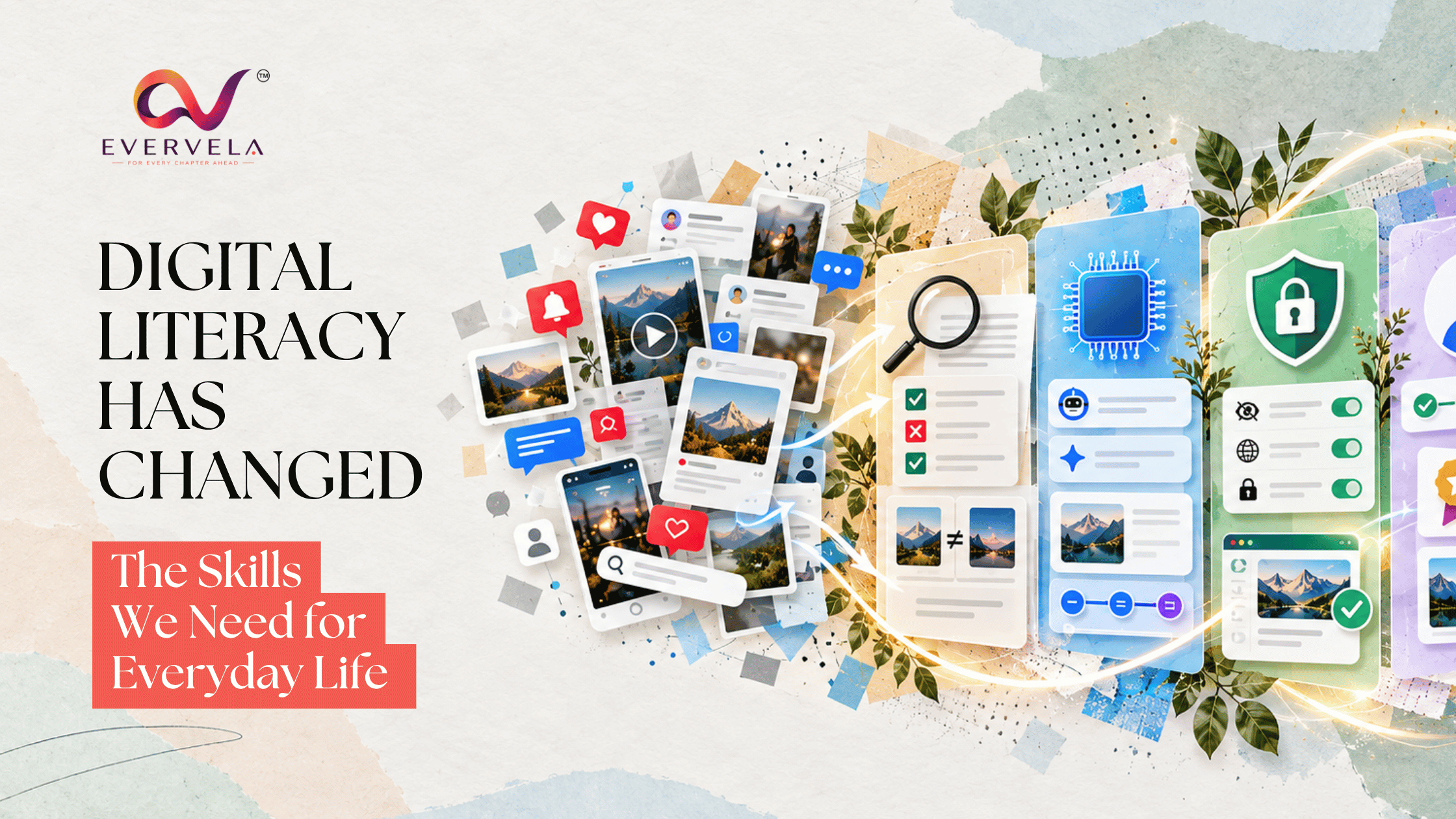
Digital Literacy Has Changed The Skills We Need for Everyday Life
October 14, 2026
Knowing how to use a smartphone does not necessarily mean knowing whether to trust what appears on it.
That may be one of the biggest changes in digital literacy today.
For years, becoming digitally capable meant learning how to use technology.
How to send an email. Search the web. Download an app. Join a video call. Make an online payment.
Those skills still matter.
But our digital life has moved beyond knowing where to click.
Today, the harder questions are often:
Is this real? Should I share this? Can I trust this answer? Why am I seeing this? What happens to my information? Should I act now, or check first?
The technology changed.
So the skills we need changed with it.
What does digital literacy mean today?
Digital literacy is the ability to use technology while also understanding, evaluating, and making informed decisions about what we encounter online.
That includes knowing how to use digital tools. But it also requires judgment, critical thinking, online safety, privacy awareness, information evaluation, and increasingly, AI literacy.
The OECD makes a useful distinction in its adult-skills work. It looks beyond “computer literacy” to whether people can use technology to solve the kinds of problems they face in everyday life.
That distinction matters.
Because most of us are not using technology simply to demonstrate that we know how it works.
We are using it to live.
A digitally confident person does not need to know everything
Imagine receiving a message from your bank.
It looks professional. The logo is right. The message knows your name. There is a link asking you to verify something.
The old digital skill was knowing how to open the link.
The newer skill is knowing whether you should.
Now imagine asking an AI chatbot a health, financial, travel, or work-related question.
Knowing how to write the prompt is useful.
Knowing when the answer needs to be checked against a reliable source is digital literacy.
Or consider a teenager watching a convincing video online.
The important skill is no longer simply finding content. It is asking who created it, why it appeared, whether it may have been altered, and what evidence supports it.
Different situation.
Same underlying ability:
Make a good decision in a digital environment.
The six everyday skills digital literacy now requires
We believe modern digital literacy skills can be understood through six simple actions:
USE
Can I use the tool well enough to accomplish what I need?
UNDERSTAND
Do I understand what the technology is doing and what information it needs from me?
QUESTION
Can I recognize when a message, claim, image, offer, or AI-generated answer deserves a closer look?
VERIFY
Do I know where to check before I believe, share, pay, respond, or act?
PROTECT
Can I make sensible choices about passwords, privacy, personal information, accounts, and devices?
CHOOSE
Can I decide when technology is useful, when I need another source, and when it is better to step away?
That last skill is easy to overlook.
Being digitally capable does not mean using every new technology.
Sometimes confidence means knowing when not to use it.
AI makes this shift even more important
AI is quickly becoming part of search, work, education, communication, customer service, and everyday decision-making.
But familiarity and confidence are not the same thing.
In 2026, Pew Research Center found that only 18% of U.S. adults described themselves as extremely or very confident using AI chatbots. Among adults 65 and older, that figure was 6%.
This is why AI literacy should not be treated as a skill only for technology professionals.
A parent needs it.
A student needs it.
An employee needs it.
A caregiver may need it.
An older adult exploring AI for the first time needs it.
And organizations introducing AI to employees or communities need it too.
The lesson does not have to begin with how AI is built.
It can begin with something much more useful:
What can this help me do, and what should I still think through myself?
Digital confidence is not an age group
It is tempting to think of digital skills as something older adults need to “catch up” on.
Real life is more complicated.
A teenager may understand an app better than a parent but know less about financial fraud.
A professional may use AI every day but still overlook privacy settings.
A grandparent may be cautious about unfamiliar links but need help navigating a new healthcare portal.
A child may know how to find information instantly but still be learning how to judge whether it is credible.
Everyone has strengths.
Everyone has gaps.
And those gaps move as technology changes.
That is why digital learning should meet people where they are, not where we assume they should be.
From knowing technology to navigating life with it
At EVERVELA, we see digital literacy as part of a much bigger idea: helping people feel more capable as everyday life changes.
That means learning through situations people actually encounter.
A suspicious text.
A first smartphone.
A new AI tool at work.
An unfamiliar online payment.
A privacy setting.
A family conversation about technology.
A question you are not quite sure you should trust Google, social media, or AI to answer.
Because the goal is not to turn everyone into a technology expert.
It is to make the next digital decision a little easier to understand.
And the one after that.
Technology will keep changing. Good judgment travels with you.
Explore EVERVELA's Digital Safety, Technology & AI Learning, and practical learning experiences to build skills for the digital life you are already living.