AI In Everyday Life. Here’s What You Actually Need to Know to Get Started.
October 19, 2026
You don't need to understand how an engine works to drive a car.
But you do need to know how to steer, when to brake, and which road to take.
Artificial intelligence is beginning to feel a little like that.
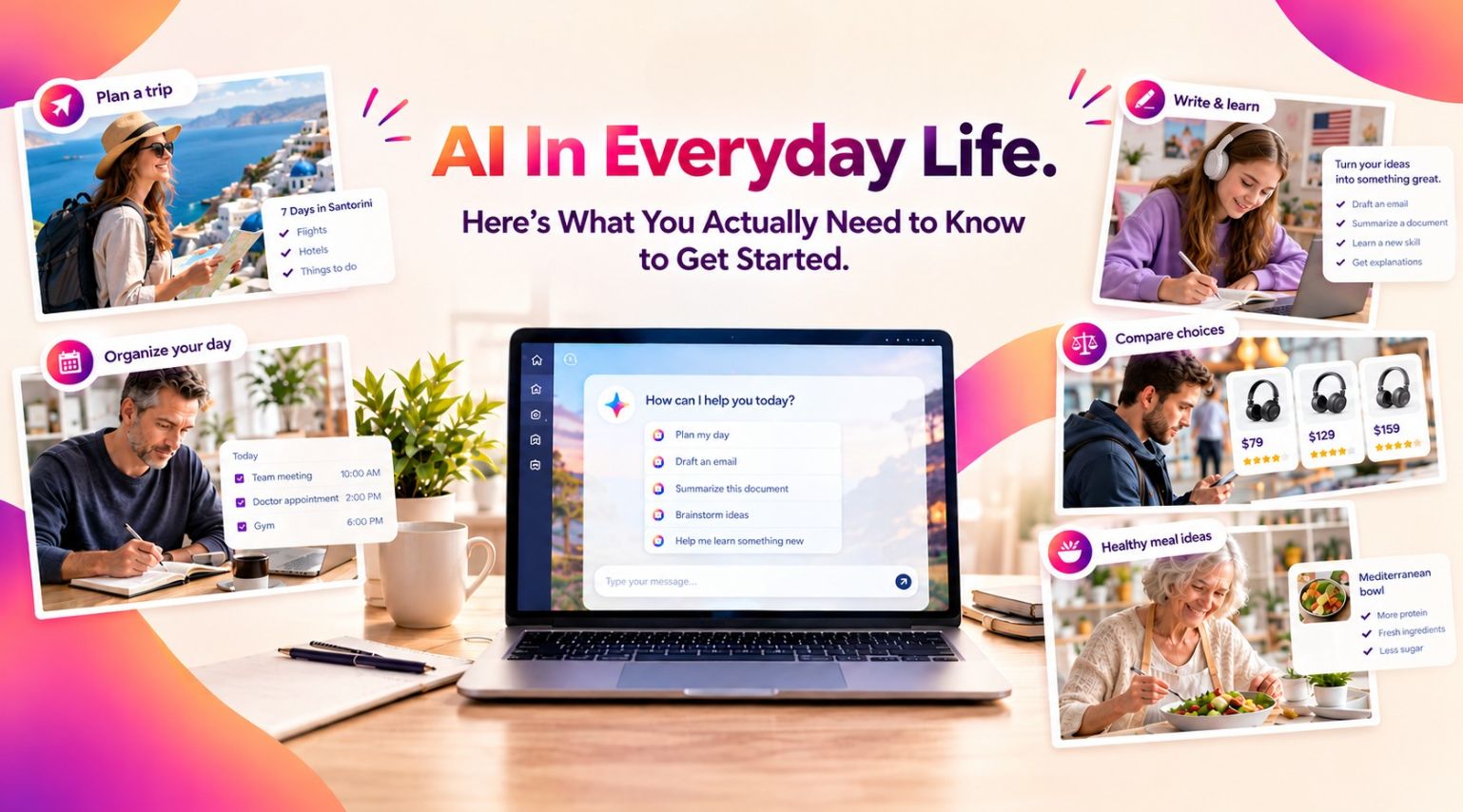
It can help you write an email, understand unfamiliar information, plan a trip, learn something new, or organize your day.
But knowing how to ask AI a question is only the beginning.
Knowing what to do with the answer is the skill that really matters.
And that's where learning about AI in everyday life becomes useful.
First, what is AI, and where are you already using it?
Artificial intelligence (AI) is technology that enables computers to perform tasks such as recognizing patterns, understanding language, making predictions, and generating content.
You may already encounter it without thinking much about it.
When your phone suggests the next word in a message.
When a navigation app estimates traffic.
When your email filters unwanted messages.
Or when an AI chatbot helps explain a topic in simpler words.
Not every AI system works the same way. Some recognize patterns or make predictions. Others, called generative AI, create text, images, audio, or other content.
Tools such as ChatGPT, Gemini, and Copilot are examples of generative AI.
And you don't need a technical background to begin exploring them.
AI is becoming familiar. Confidence is another story.
According to Pew Research Center's 2026 study, 49% of U.S. adults have used AI chatbots. Yet only 18% say they are extremely or very confident using them.
That tells us something important.
People are encountering AI faster than they are becoming comfortable with it.
But AI literacy isn't about keeping up with every new tool.
It's about understanding what AI can help with, recognizing its limitations, and using it in ways that make sense for your life.
Five everyday situations where AI can help
Let's move away from complicated technology demonstrations and look at ordinary life.
1. When you need something explained
Received a document full of unfamiliar terms?
AI can help explain general concepts in plain English. You can ask for examples or a simpler explanation.
For important medical, legal, or financial information, check the original source and consult a qualified professional.
2. When you're staring at a blank page
An email to your child's teacher. A birthday message. A first draft of a resume.
AI can help you organize your thoughts and find the right words.
You still decide what sounds like you.
3. When you're learning something new
Want to understand online banking, practice conversational Spanish, or learn about a new hobby?
AI can explain concepts, create practice questions, and guide you through unfamiliar topics.
4. When you're organizing everyday tasks
Planning a family gathering? Preparing a packing checklist? Trying to make sense of a busy week?
AI can suggest a starting plan that you can adjust to your needs.
5. When you need help comparing options
AI can help you identify questions to ask when comparing products, services, or travel options.
Use it to organize your research, then check current prices, terms, and details directly.
The common thread?
AI can help you prepare, understand, and organize. You remain in charge of the decision.
The three questions to ask before trusting an AI answer
Here's a simple habit worth developing.
Whenever AI gives you something useful, ask:
1. Does this make sense?
AI can produce confident-sounding answers that contain mistakes.
Read the response carefully. If something seems unusual, ask for clarification.
2. Can I verify it?
For facts, statistics, policies, health information, or financial decisions, check reliable original sources.
An answer that sounds convincing isn't automatically correct.
3. Should I share this information?
Avoid entering passwords, banking details, identification numbers, private medical records, or someone else's confidential information into an AI tool.
Review the tool's privacy settings before sharing personal details.
These habits form the foundation of responsible AI use.
Try AI for yourself: One task, five minutes
If you're wondering how to use AI for the first time, begin with something familiar.
Open a reputable AI chatbot and try this:
“I'm new to AI. Explain how it can help me plan a family gathering. Use simple language and give me five practical ideas.”
Read the response.
Ask a follow-up question.
Change something in the suggested plan.
Notice what helps and what doesn't.
That's your first lesson in using AI in everyday life.
You don't need the perfect prompt. You need a clear question and the curiosity to explore the answer.
AI learning should begin with your life, not your age
A student may want help understanding a subject.
A working professional may want to save time on routine writing.
A parent may want to understand the AI tools their child encounters.
An older adult may want to explore technology at a comfortable pace.
Different starting points. Different reasons to learn.
At EVERVELA, we believe AI learning should be practical, approachable, and relevant to real-life needs.
It's why we connect Technology & AI Learning with digital literacy, online safety, and everyday decision-making.
Because becoming comfortable with AI isn't about using it for everything.
It's about knowing when it can help.
You don't have to keep up with every new AI tool. Start with one thing that matters to you.
And build from there.
Your next step starts here
Curious about AI but unsure where to begin?
Explore EVERVELA's Technology & AI Learning offerings and discover practical ways to build your skills and confidence.